

For companies, making the right choice in selecting a CAD Software is a significant investment, but the selection is only half the decision, but the other part depends on how the software’s license type is selected, for example SOLIDWORKS Perpetual vs Subscription Licensing.
For industries that are looking forward to adopting SOLIDWORKS, that comes down to the choice of either owning a perpetual license or paying to use it as a subscription model type. So, there is no universal perfect answer. The right one depends on how long you will use the software, how often you upgrade, how your team expands, and how your business model prefers to spend-either upfront or over time. For India’s small and medium manufacturers especially, this decision touches cash flow, business model, and tax treatment in ways that a global pricing list never, discloses.
SOLIDWORKS Perpetual vs. Subscription: What’s Actually the Difference?
The two terms that they hear during the decision are “Perpetual” and “Subscription” model, so it’s worth being precise–because they are not quite the opposite of each other, as they are often mentioned.
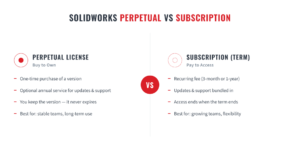
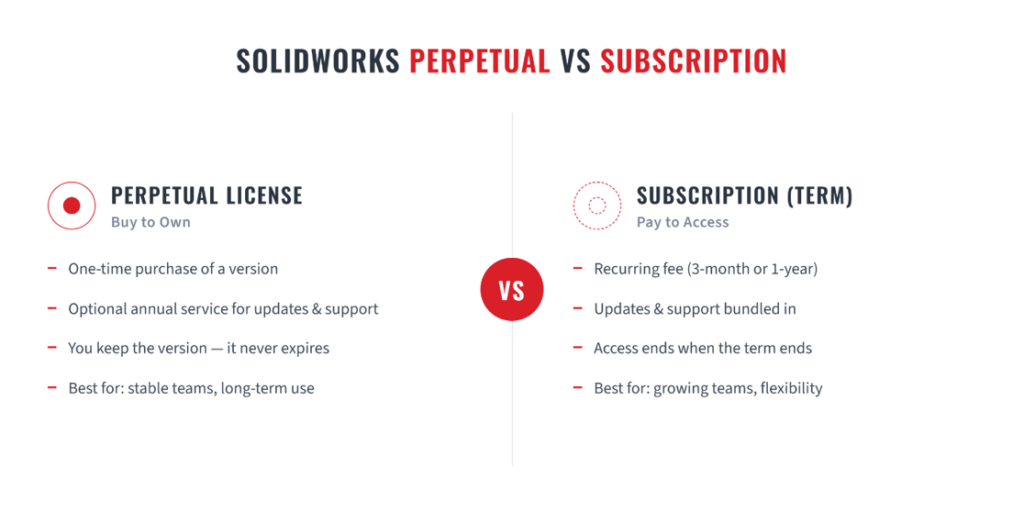
A perpetual license model involves a single-time purchase. You basically buy the right to use specific versions of SOLIDWORKS, which does not expire–the software keeps running for as long as your hardware and OS support it. To keep receiving the new versions and get technical help, you might need an optional subscription on top of it. So, when you stop paying it, you keep the version till the subscription end date and only the upgrades & support get stopped.
A term (subscription) license model is access to the tool rather than ownership. You opt to pay a recurring fee typically between three months and a year. In this period, the software, updates, and support are all bundled together. When the term ends, so does the access unless you choose to renew.
One common point applies to both: starting from June 2023, for every seat of SOLIDWORKS purchases now connects to 3DEXPERIENCE Cloud Services, so cloud storage and collaboration increasingly sit alongside whichever model you choose.
In short: Perpetual is buy-to-own a version; Subscription is pay-to-access.
Look Beyond the License Price
Most companies open with “How much does it cost?” The more useful question is “How does the cost fit the way we run the business?”
A perpetual license carries a larger upfront cost but a lower running cost attractive if you will use the software for years and want to treat CAD as owned infrastructure. While the subscription model lowers the initial investment cost and spreads into predictable payments – attractive for newer teams that involve team size expansion, evolving roadmaps, or businesses that prefer steady expenditure to a large one-time outlay.
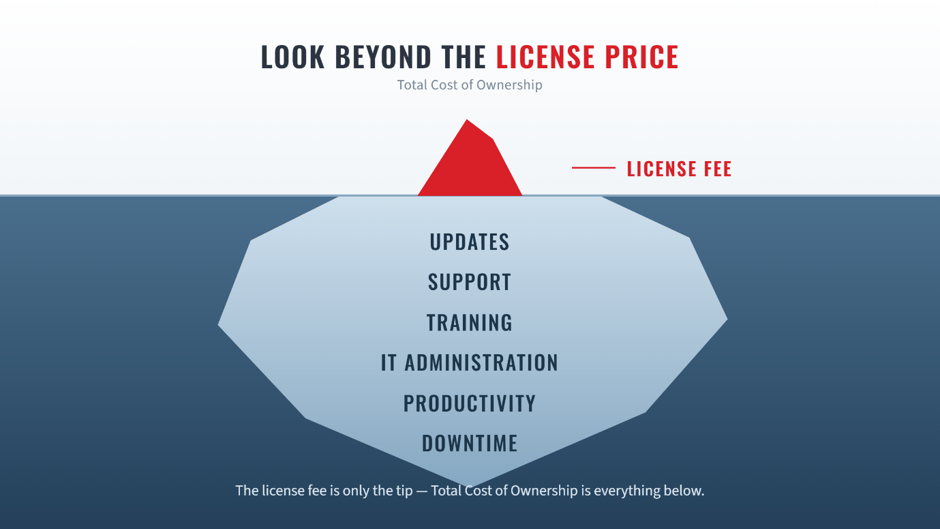
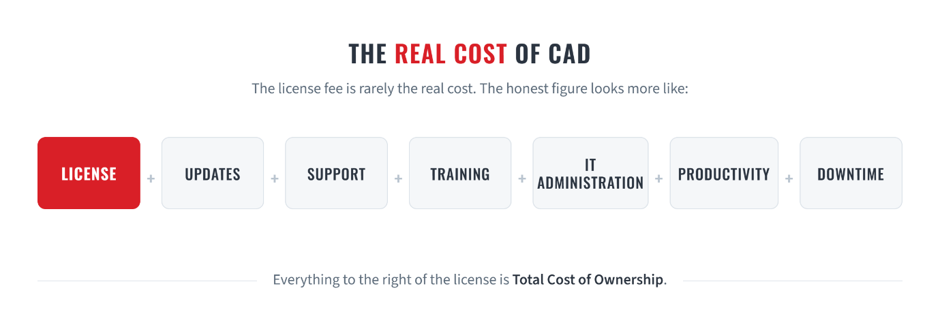
But the license fee is rarely the real cost of CAD. The honest figure looks more like
A cheaper license that leaves the team wrestling with outdated software or slow support can cost far more in lost productivity than it actually saves in the real time. That is why the Total Cost of Ownership (TCO) measure over the period you will actually use the software beats a first-year price comparison every time.
Why This Decision Is Different for Indian Manufacturers?
Global comparisons – In general top at the stage of “upfront vs recurring”. For our very own Indian manufacturing companies, three local factors often matter the most:
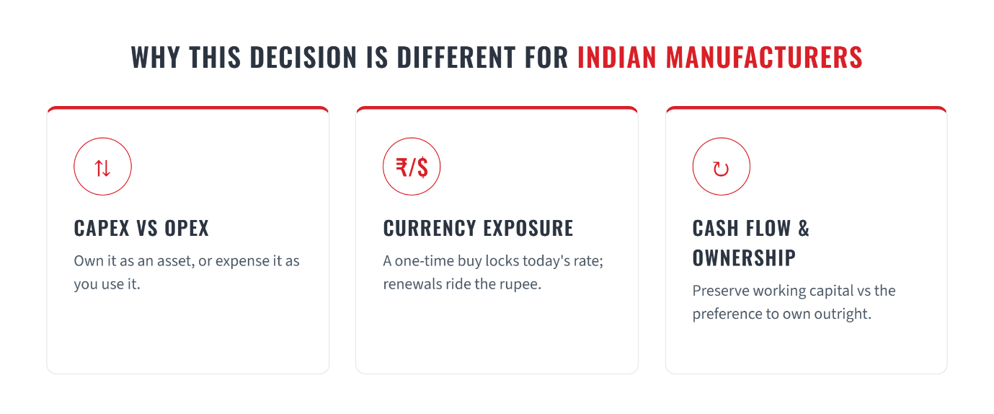
- CAPEX VS OPEX: A perpetual license is typically a capital expenditure – an asset that’s capitalized and depreciated over time, while the subscription is an operating expense, which is accounted for you use it. That distinction affects the tax planning for the organization, how they can organize and make the cost land on their books, and from which budget it draws.
- Currency exposure: A one-time perpetual purchase largely fixes your cost at today’s price. A subscription, by contrast, is exposed to periodic list-price revisions — so the amount you renew in a few years may be higher than what you pay today. For multi-year planning, that difference is worth weighing. But the AMC cost for a perpetual license year on year brings the value to a greater number of years.
- Cash flow and ownership: MSMEs often run on tight working capital, where operating cost preserve cash for machinery, hiring or expansion. At the same time, many Indian companies prefer to own an asset than carry an ongoing commitment. These instincts pull in opposite directions – which is exactly why the choice deserves a deliberate look and not a default one.
Which Model Fits Your Business? SOLIDWORKS Perpetual vs Subscription
A subscription license tends to fit companies that are:
- Standing up a new engineering team or expecting requirements to evolve
- Keeping upfront investment low and cash free for other priorities
- Scaling designers up or down, and wanting predictable recurring spend
- Keen to always run the latest capabilities
A perpetual license tends to fit companies that:
- Treat CAD as a long-term asset and prefer to own it outright.
- Have a stable, established team and steady product portfolio.
- Change their software environment infrequently.
Consider two manufacturers, both with five designers. One has an established product range and a multi-year horizon—it may value ownership and lower long-run cost, so perpetual is worth evaluating. The other expects to double its team in two years and wants minimal upfront spend—subscription may fit better. Same starting point, different business shape, different answer.
A Quick Self-Check
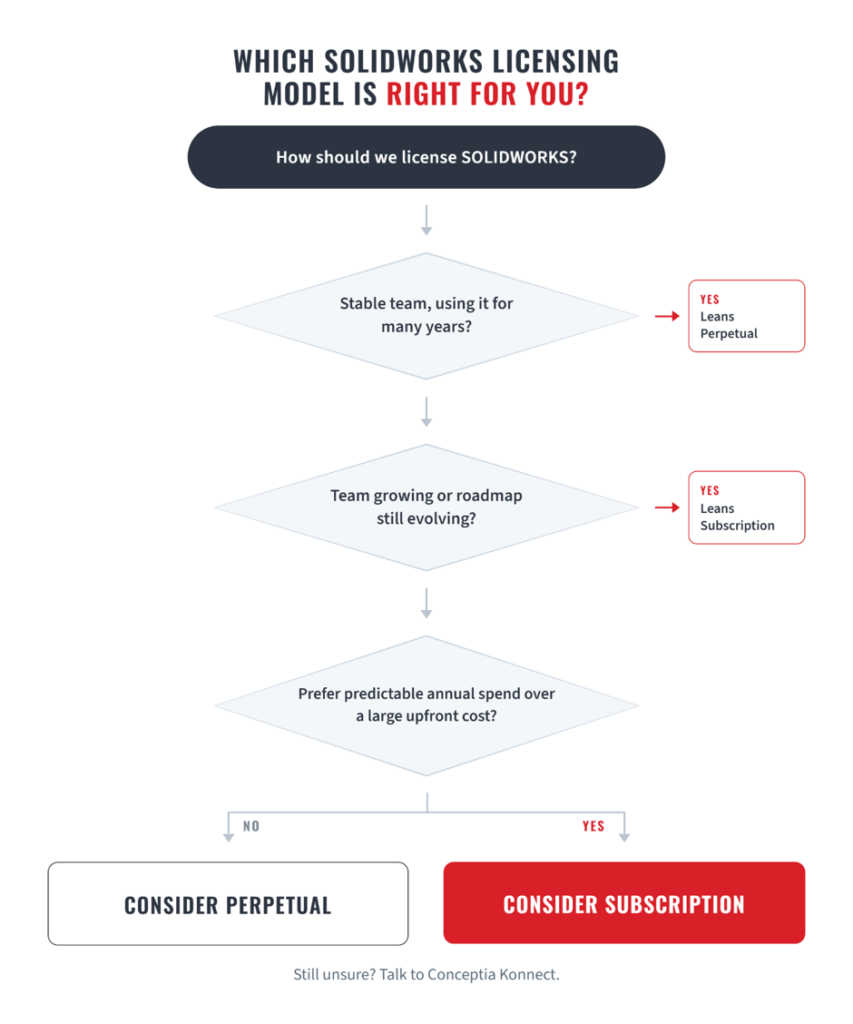
Five questions usually surface the right direction:
- How long will we use SOLIDWORKS? Judge the economics over your real usage period, not year one.
- How often do we upgrade? Frequent adopters get more from continuous access to current versions.
- Is our team growing? Rapid expansion Favors flexibility and predictable spend.
- Does finance prefer capex or opex? This often decides more than the headline price.
- How much do we rely on support and new features? For productivity-sensitive teams, that value is easy to underweight.
At a Glance
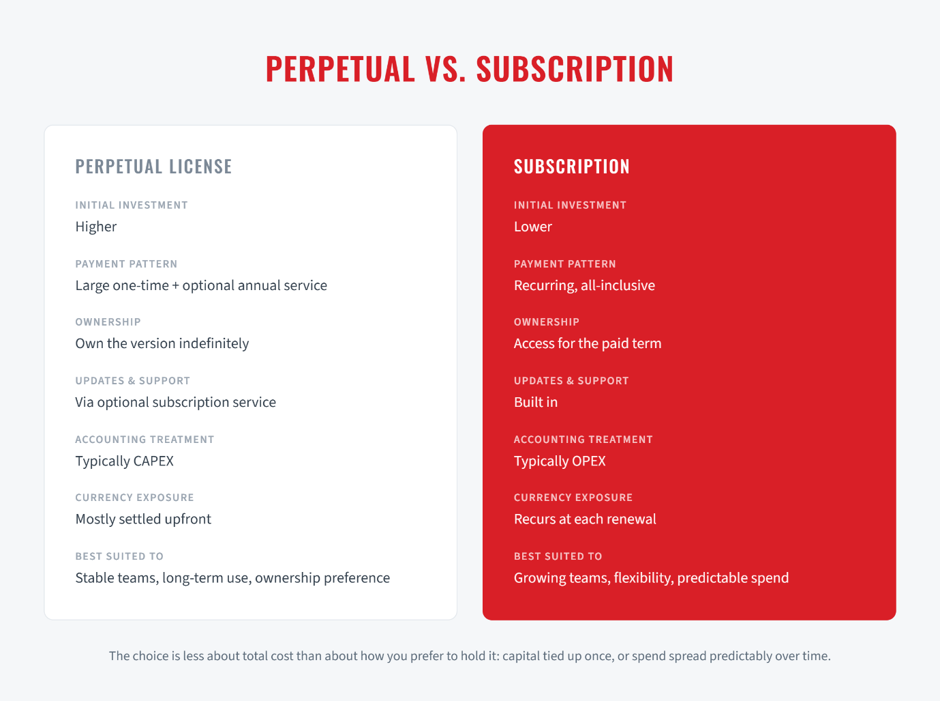
Note: Licensing features, entitlements, pricing, and commercial terms change over time and can vary by product and region. Please confirm the current applicable SOLIDWORKS terms before purchasing.
Think Beyond CAD
For most companies, licensing is only the start. As engineering matures, needs grow past 3D CAD—into product data management, simulation, design automation, visualization, and cloud collaboration. A licensing decision made today should support that wider roadmap, not just this year’s CAD requirement.
Conclusion
Choosing between a SOLIDWORKS subscription and perpetual license isn’t simply about buying software. It’s a decision about how your organization wants to manage its engineering technology investment. A growing company may prioritize flexibility and predictable expenditure; an established one may prioritize ownership and long-term value. Both are right—when matched to the business behind them. The best licensing model isn’t the one with the lowest initial cost. It’s the one that gives you the right balance of cost, flexibility, engineering productivity, and long-term value.
Need Help Choosing the Right SOLIDWORKS Licensing Model?
Every organization has a different mix of engineering needs, team size, budget, and growth plans. If you’d like to work out which SOLIDWORKS licensing approach fits yours, Conceptia Konnect can help you map the options against your engineering and business requirements.
Contact us at marketing@ckonnect.in to discuss your requirements and find the right SOLIDWORKS solution for your organization.
Author Details:

Ramesh Aravind is a Customer Success Associate based out of Chennai, Tamil Nadu. He has completed Master’s in Engineering with specialization in Industrial Metallurgy. He had joined Conceptia Konnect team in August, 2022 and has a good experience in SOLIDWORKS, Simulation & 3DEXPERIENCE solutions.