

Antenna placement plays an important role in modern communication systems. Whether it’s for drones, vehicles, or handheld devices, the position of an antenna will directly affect its performance. Proper antenna placement using CST Studio Suite always ensures strong connectivity and reliable communication between the devices.
This blog provides an overview of antenna placement using hybrid solver techniques. CST Studio Suite Software has the capability to combine multiple advanced electromagnetic solvers for system-level analysis, allowing us to evaluate how surrounding structures will influence antenna performance. By using this approach, we can determine the optimal antenna position that minimizes reflection and interference.
In this blog, we focus on GPS antenna placement for drones, which is critical for precise location tracking and navigation. Proper positioning of the GPS antenna not only enhances signal strength but also improves overall performance. Through this simulation-driven approach, we can ensure the ideal location of the GPS antenna to maximize its signal strength and reliability.
ANTENNA DESIGN WITH RESULTS:
Designing an antenna begins with selecting a suitable type of antenna for the intended application. For drone GPS, a patch antenna is commonly used due to its compact size and unidirectional performance. With the help of CST software, we can design the antenna with respective design parameters and virtually test its performance. Initially, the antenna is tested as a standalone unit to verify its functionality. Fig. 1 shows the GPS antenna design along with the return loss (S11) and far-field gain. It also allows us to optimize the design before moving to fabrication, thus improving the performance and reducing time to market.
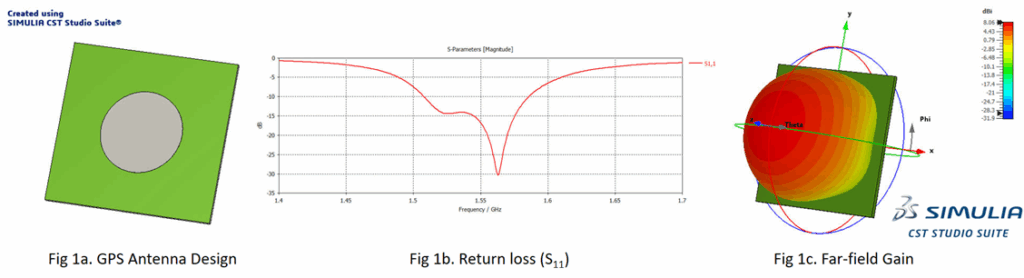
Fig. 1: GPS patch antenna design and simulation results.
ANTENNA PLACEMENT Using CST Studio Suite:
Once the antenna is simulated, the appropriate CAD model is imported into the CST software. The software supports CAD import from different tools like SolidWorks, CATIA and CREO, etc…
CST Studio Suite’s hybrid solver approach is designed to handle electrically large and complex electromagnetic structures. It combines multiple solvers in a single simulation run. An antenna itself requires a full-wave time domain solver to accurately capture its near-field behavior of it. When this antenna is placed on a structure, the platform becomes electrically large and running a single full wave time domain solver for the entire simulation model would be extremely slow and memory intensive.
To overcome this, we use a hybrid solver technique, which applies full-wave time domain solver for the antenna and an Integral or Asymptotic solver for electrically large models. By combining these solvers, CST software captures the complete behavior of the antenna with its surroundings while reducing simulation time and memory usage.
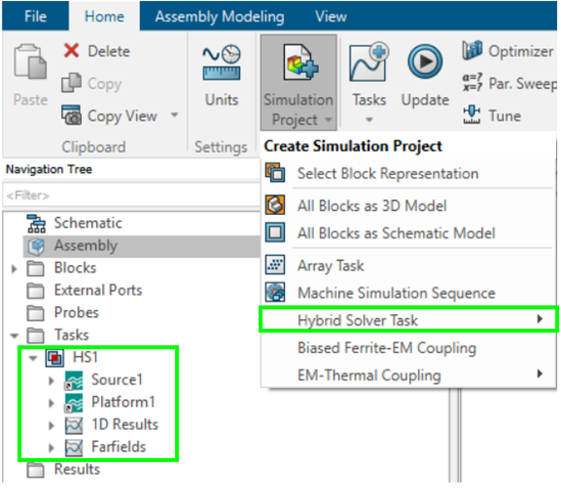
Fig. 2: Hybrid solver task setup in CST Studio Suite
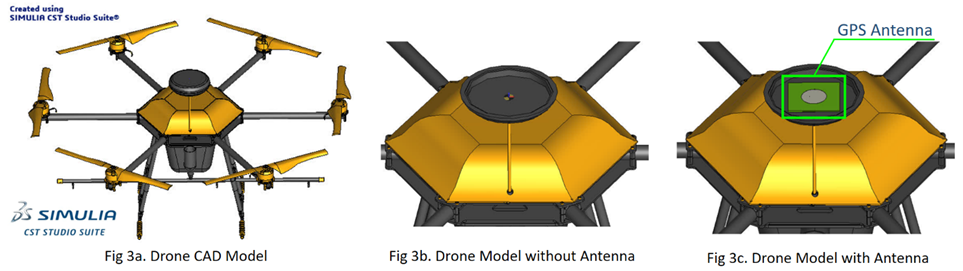
Fig. 3: GPS antenna placement on drone model.
ANTENNA PLACEMENT WITH RESULTS:
The simulation output illustrates the performance of the GPS antenna placed on the drone model. As shown in Fig. 4, the 3D far-field radiation pattern represents how the antenna radiates and interacts with the surrounding structures. The Return loss graph shows the efficient power transfer, and E-field distribution visualizes the electric field propagation around the antenna. These results help in understanding the interaction between the antenna and the drone for proper antenna placement to achieve better coverage and connectivity.
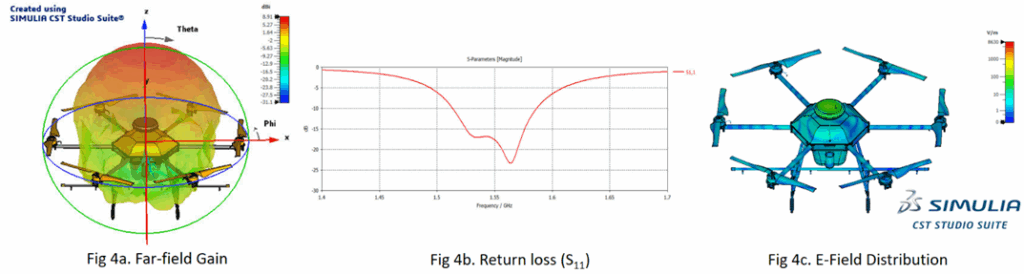
Fig. 4: Performance of the GPS antenna mounted on drone model.
“CST Studio Suite – hybrid solver technique is an effective method for simulating antennas on electrically large models. It combines multiple electromagnetic solvers in a single simulation platform, making it faster and more accurate. Using this approach, we can find the most suitable position for the antennas to minimize reflection and interference. By optimizing antenna placement early in the design stage, we can improve the performance and reduce the number of design iterations.”